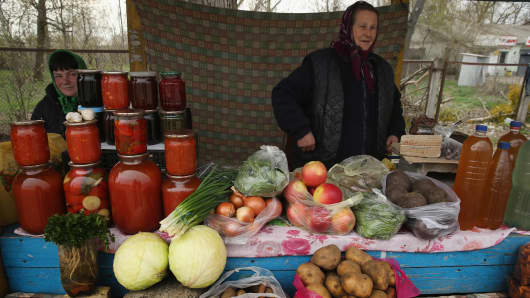
While many rural towns across Eastern Europe face economic
struggle, the Ukrainian region of Polesia, 200 miles east of the
Chernobyl nuclear disaster site, has become something of a boomtown for
foragers seeking mushrooms and berries — nearly all of which are
contaminated with radiation.
It has
become a good, if unlikely, business, and helped Ukraine become a berry
exporter to the European Union, University of Maryland historian Kate
Brown writes in the magazine Aeon.
Brown
notes that in 2015, Ukraine exported 1,300 tons of fresh berries and
17,251 tons of frozen berries to the European market. That is more than
30 times as much as in 2014.
The berry picking brings in money for locals as well. A picker can earn $20 to $30 a day, whereas a local schoolteacher earns $80 a month.
However,
Brown also says there could be some hidden costs — the berries end up in
the hands of European customers who often do not know they are
ingesting foods containing radioactive isotopes. In addition, Brown
notes, the berries can be labeled organic, since radioactivity is not
covered under common organic designations.
And the locals who are harvesting the berries may be suffering the effects of accumulated radiation. There is evidence of higher rates of certain birth defects and diseases in some of the areas affected by the disaster.
Data: 30.11.2016
Fonte: www.cnbc.com
Nessun commento:
Posta un commento